Return To Map
*Editor’s Note: The following partial research paper was recovered from the lab of Olvre the Most Learned after their tragic and completely unforeseen plummet from the roof of the Eskim Materials Research Building. Absolutely horrible, truly.
So far as we are aware, none of the Spire staff nor any of Olvre t.M.L.’s competitors in the field knew the nature of the experiments they were performing. Our… timely acquisition of this paper, as well as their research notes and samples of the extracted dreamglass, will allow the Quarrel to disseminate the information in whatever manner they see fit.

“Enhancing the Design of the Dreamglass Storage Unit: A Novel Chemoengineering Process to Facilitate Stable Extraction of Greater Quantities of Dreamglass for Usage in M-DIAF Harvesting” (682-36)
AUTHOR
Olvre the Most Learned, The Spire University
PROBLEM
The rapid waning potential of extracted Moonborn-Derived Immuno Augmentative Fluid (M-DIAF) in both storage containment and anthrid bodies.
BACKGROUND
M-DIAF, commonly referred to as "magic" by most, is an incredibly powerful resource and can be used to heal anthrids on the very brink of death. Notwithstanding, there are significant constraints to its usage by the lay public and by medical staff throughout Auliem. One of these myriad issues is the waning potential of M-DIAF once it has been extracted from a moonborn. (See: Eskim 462-14; Deng, Pelk, and Olvre 679-43.) The rapid decay - better termed “depotentiation” as the fluid itself does not disappear, but seemingly loses its restorative property - has been previously charted by Quin and Astor (597-27). Within an anthrid body, the depotentiation follows a rapid exponential decay function:
Where d(i) represents the initial dosage of M-DIAF extracted and t represents the amount of time in minutes post-extraction. Enormous amounts of healing potential are lost simply because M-DIAF is highly unstable when transferring planes from Draumir to the Marble. (For other critical measurements of M-DIAF, including average and maximum extractive dosages of operans and kudrans, the minimal healing dosage (MHD) for various wounds, and formulae predicting exhaustive potentiation of a moonborn per draum of magic extracted, see Deng and Pelk 674-3 and Deng and Pelk 679-43.)
The invention of the Dreamglass Storage Unit (DSU) by Storek and Xertem in AE 642 has increased the stability of M-DIAF significantly, leading to a new decay function:
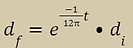

Though the DSU has its own set of constraints, primarily in the maximum dosage of M-DIAF that can be infused, it does allow for an attenuation of the depotentiation effect. This formula is particularly salient in consideration of transport of M-DIAF between Hondrouk extraction cells and the Great Hospital of Zetia. Though the two cities are proximal, caravans transporting M-DIAF to Zetia nonetheless require an hour’s transport time, at which time by the above formula the M-DIAF has decreased to 65.041% of its original potency. This may seem like an enormous deficit, but when analyzed in comparison to the decay within an anthrid body, it yields a staggering 146% increase of usable M-DIAF.
Since Storek and Xertem’s invention, many have attempted to improve upon the DSU to virtually no success. Dreamglass is an extremely volatile and fragile mineral and is not easily harvested in large intact pieces. While mining techniques in Hondrouk have advanced over the past two decades, there have been no breakthroughs in improving the stabilizing effects of the DSU. Any augmentation, even a slight one, would yield unimaginable benefit to the ailing in Zetia… and unimaginable profit and fame to the inventor.
METHODOLOGY
Dreamglass, though similar in appearance to obsidian and other volcanic glasses, is technically classified as a soft metal (for a full list of metallurgical properties of dreamglass, see Eskim 465-41). It is well known that medical grade potassium iodide solution, among many other chemical substances, is capable of dissolving dreamglass, but any attempts to harvest the dissolved dreamglass had, until now, proven impossible.
For this experiment, chips of dreamglass were fed into a basin of liquid potassium iodine solution until a saturation point had been reached and the dreamglass no longer dissolved, but rather floated atop the solution. A Dorpit-grade coldbox (see Dorpit, 674-22) was then used to lower the temperature of the basin to -87 thaums, just above the freezing point of the solution. In this condition, a semisolid dreamglass substrate began to form at the bottom of the basin.
Extraction of the substrate was carried out with a seven-Garrop magnetic field generated by a common hand magnet. Upon dragging the mag-
net across the top of the solution in a waxing and waning motion, thin strands of the substrate began to rise through the solution toward the magnet. These strands, which proved to be soft and malleable (of a similar quality to gold or potassium), coalesced on the end of the magnet and were able to be removed with a counter-field.
The experiment was carried out four separate times, each yielding a large harvested chunk of dreamglass which, when heated to room temperature, returned to the known and expected chemical structure for use in DSUs.
RESULTS
The four dreamglass spheres were tested using the Bockdel Method (Bockdel and Alesa, 472-4) to confirm their chemical and physical properties [Table 1]. Each weighs between three and four pounds and their diameters measure two to three hundred percent longer than the largest intact chunks of harvested dreamglass on scientific record.
When tested for infusion, the spheres were capable of holding, on average, 78 draums of M-DIAF [Table 2]. This represents a 41.8 percent increase in infusion capability. Curiously, when depotentiation was tested, it had also improved despite the lack of chemically significant differences between the newly extracted dreamglass and previously utilized samples. The novel depotentiation function was calculated as:
which represents a scientifically fascinating, albeit slight, attenuation effect.
CONCLUSIONS
Though this novel method of extracting and amalgamating dreamglass does not technically improve upon the design of the DSU, it does allow for larger amounts of solid, stable dreamglass to be created for use in current DSUs. The implications of this method are far-reaching and neoparadigmatic; as an example, the Hondrouk-Zetia Transfer (HZT) could provide grea
